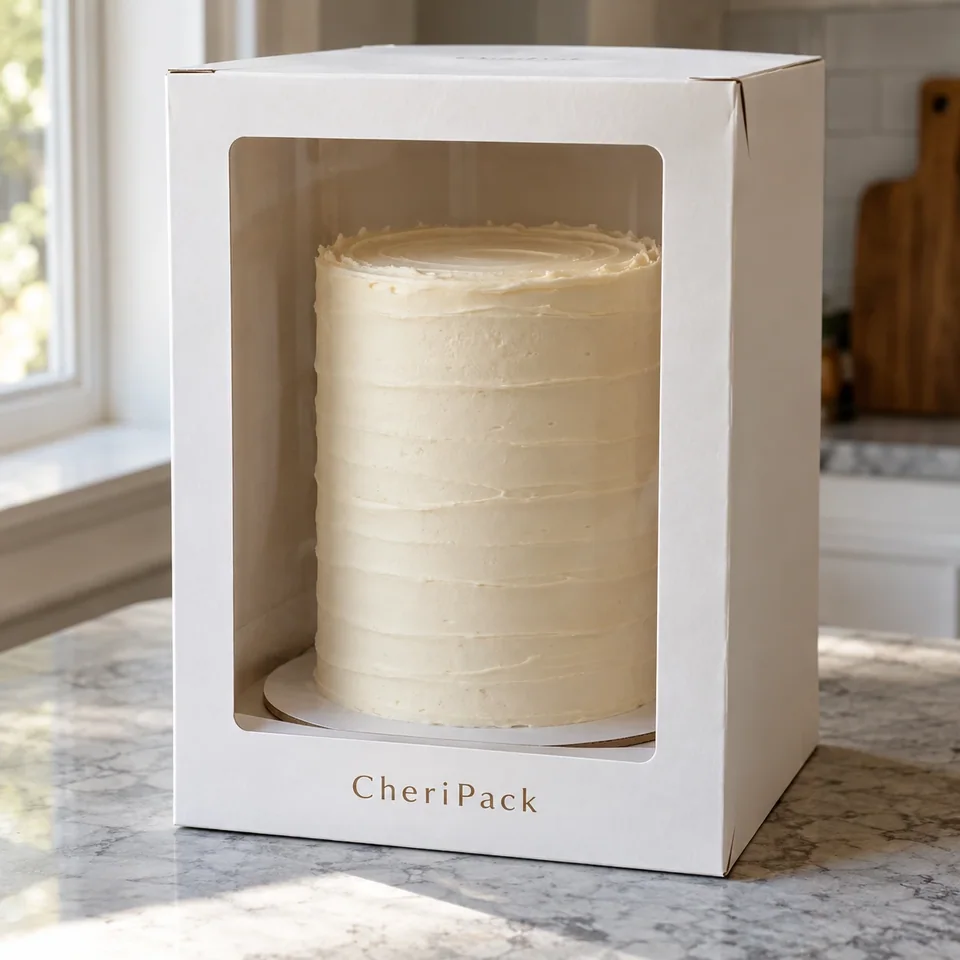
Record four measurements before choosing a carton
Measure the board at its widest points, the widest finished decoration, the total height from the bottom of the board to the highest topper, and the filled weight. Include a raised board or drum. State whether the topper travels fitted or is added later; those are different packing configurations.
As a simple fit example, a cake that is 280 mm high after decoration cannot fit inside a carton with only 250 mm of usable height. This is an illustration of measurement, not a recommended allowance. The actual clearance must suit the decoration, loading motion and agreed structure. Do not substitute an outside carton dimension for clear internal height.
Choose an entry and exit path
A top-loaded box can require hands to reach past fragile decoration. A side-opening structure can offer a different loading motion. Review how the baker places the cake on the base, closes the carton and removes it at handover. Include any insert or locator that restricts movement.
Use a representative decorated cake or a suitable accurate fit model when reviewing the structure. Check the highest and widest details, not only a plain cylinder with the same nominal diameter. A window, flap or internal seam should not contact the decoration during closure.
Keep support separate from the carton walls
The cake board supports the cake; the carton surrounds it and needs a reviewed base and handling method. A board that slides inside the carton can bring decoration into contact with a wall. A very tight fit can make loading or removal difficult. Review the seated board and the carrying arrangement together.
Tall, multi-layer and multi-tier cakes are not interchangeable briefs. List the actual configuration and ask the baker to define cake supports and any assembly at the destination. Choosing a taller paper carton does not solve the internal stability of a cake or establish suitability for parcel delivery.
Add the outer carry bag only after the box is fixed
If the customer receives a bag, size it from the closed, filled carton exterior, including a projecting handle or other feature. Its base should accommodate the intended orientation. Review whether staff can insert and remove the carton without tipping it or catching the lid.
State the complete order weight and the planned carrying method. A bag handle should not be treated as a substitute for supporting a cake box correctly. For an integrated carton handle, inspect the grip, locking points and base with the actual filled configuration.
Specify storage and handling conditions
Tell the supplier whether the filled box is chilled, exposed to moisture or used for another defined packing condition, and state the expected duration. Include the window, liner and direct-contact components in the material brief. An attractive bakery photograph does not establish performance under every temperature or humidity condition.
Create a repeatable handover checklist for the bakery team: the correct board and carton version, the approved opening and closure steps, the carry orientation and any separate transport instructions. This guide addresses packaging fit; it does not replace the baker’s cake-support or food-handling procedure.
Compare the decisions
| Measurement or decision | Include | Check on the sample |
|---|---|---|
| Board footprint | Full board or drum, not only cake diameter. | Seating and movement inside the base. |
| Decorated envelope | Topper, side piping and raised details. | Clearance with the box closed. |
| Loading method | Top, side or another reviewed opening. | Insert and remove without touching decoration. |
| Outer bag | Closed carton exterior and filled weight. | Pack and carry in the intended orientation. |
Your next-step checklist
- Board length/width or diameter and board thickness.
- Maximum decorated width and total height with units.
- Filled weight and intended carton opening.
- Window, liner, locator and contact requirements.
- Storage conditions, carry method and any matching bag.