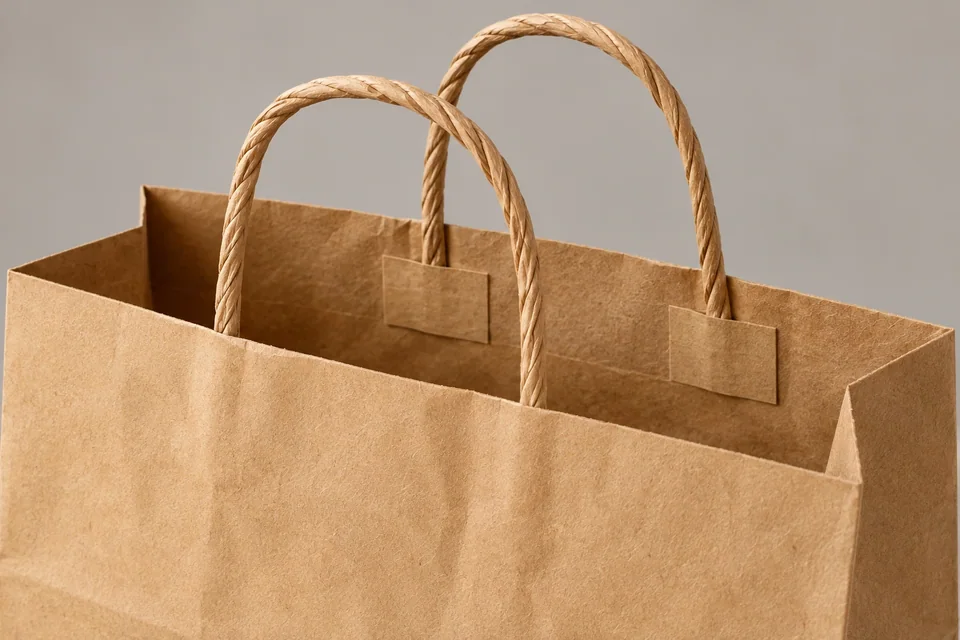
Twisted paper: inspect the fixing as well as the loop
A twisted paper handle gives a rounded grip. Its ends are secured to the bag through an agreed attachment construction, often with fixing patches. Review those contact areas and the body paper together. A close-up of the loop cannot show whether the completed bag and base suit a heavy boxed purchase.
Ask for the visible drop, grip clearance, fixing position and paper grade in the specification. Try inserting and removing the actual boxed product. Handle fixings can take up interior room and may catch a tightly fitted carton even when the bag front seems wide enough.
Flat paper: compare width, folds and carrying space
A flat paper handle is a folded paper strip, not a fabric ribbon. The grip can have a squared profile, with its ends attached to the bag according to the construction. Specify the strip width and attachment rather than substituting a ribbon specification because both look like broad bands.
Review how the paper bends where the customer holds it, and check the handle in the position used for carrying. Confirm that the two loops offer enough hand space above the packed product. A sample should represent the actual width, folds, attachment and reinforcement rather than only the artwork.
Die-cut: reserve room above the contents
A die-cut grip is an opening through the bag top, without separate attached loops. The hole shape, edge and remaining paper around it matter. A folded or reinforced upper area can be part of the design, but its exact construction needs to be specified and checked.
Separate usable packing height from total finished height. Contents that fill the bag all the way to the cutout can obstruct the hand or force the top apart. Include the grip position on the drawing and review the filled bag from the customer carrying position. Do not transfer a loop-handle load assumption to this different geometry.
Treat the base and the contents as part of the handle decision
A rigid carton, loose retail items and a broad bakery box create different carrying arrangements. State the complete filled weight, where the items sit and whether they have sharp or concentrated contact points. Review the side gussets, bottom fold and any support card with the chosen handle.
For bakery handover, start with the filled carton exterior and whether it must remain level during insertion. A handle choice cannot correct a bag base that is too narrow. If the food is already enclosed, state that; a separate outer bag and a bag that directly contacts food have different material briefs.
Make the approval reproducible
Keep the bag size, paper grade, handle format, attachment and intended load on one written sample record. Agree the practical carrying and any formal test requirements rather than publishing an unsupported universal kilogram rating. Retain the approved physical reference for repeat orders.
A ribbon handle can be another option for a kraft gift bag, but it is a separate construction. Name the actual ribbon or rope material and fixing method. A photograph that looks like cotton or satin does not establish composition, just as a kraft color does not establish recycled content.
Compare the decisions
| Handle | Construction to specify | Filled-sample question |
|---|---|---|
| Twisted paper | Cord, drop, end fixing and patches. | Do the fixings, top and base support the agreed contents? |
| Flat paper | Paper-strip width, folds and fixing areas. | Is there enough grip space without awkward bending? |
| Die-cut | Hole geometry, top clearance and reinforcement. | Can the customer grip it without the contents blocking the opening? |
Your next-step checklist
- Finished width × height × gusset with handle measurements separate.
- Packed product exterior, total weight and placement.
- Paper grade, reinforcement and actual handle material.
- A drawing showing grip, attachment and logo clearances.
- Filled packing and carrying checks recorded with the sample revision.